


AI in HR: Examples of AI Integration in HR Processes
AI in HR is reshaping how organisations hire, manage, and support their workforce. From automated recruitment and personalised onboarding to predictive analytics and real-time employee insights, AI gives HR teams faster processes, smarter decision-making, and a competitive edge. As workforce complexity grows, AI has become essential for modern HR.
What is AI in HR?
The term AI in HR generally refers to the use of AI-powered apps and generative AI to automate or enhance processes and to extend the capabilities of HR professionals.
One of the earliest and best AI in HR examples is the deployment of Artificial Intelligence in recruitment software to automate candidate screening and candidate relationship management.
Generative AI tools like ChatGPT are now enhancing and extending HR capabilities exponentially, allowing HR teams to complete normally lengthy tasks in a fraction of the time.
Why AI Matters in HR Today
Growing complexity in workforce management
The flexible working revolution has been great for employee engagement. However, supporting the different types of employment contracts and working arrangements has meant that workforce management is becoming increasingly complex.
This has overwhelmed many organisations who struggle with the conflicting dynamics of today’s hybrid working environment. One of the benefits of AI in HR is that it can address the growing complexity of workforce management by automating key areas of HR engagement sustainably across a complex and diverse hybrid workforce.
Staying ahead of the competition
Businesses that are slow to integrate AI in HR are falling way behind best practice norms, illustrated by Gartner research which shows that around 60% of companies are currently in the implementation phase of integrating AI in HR to enhance efficiency and drive innovation.
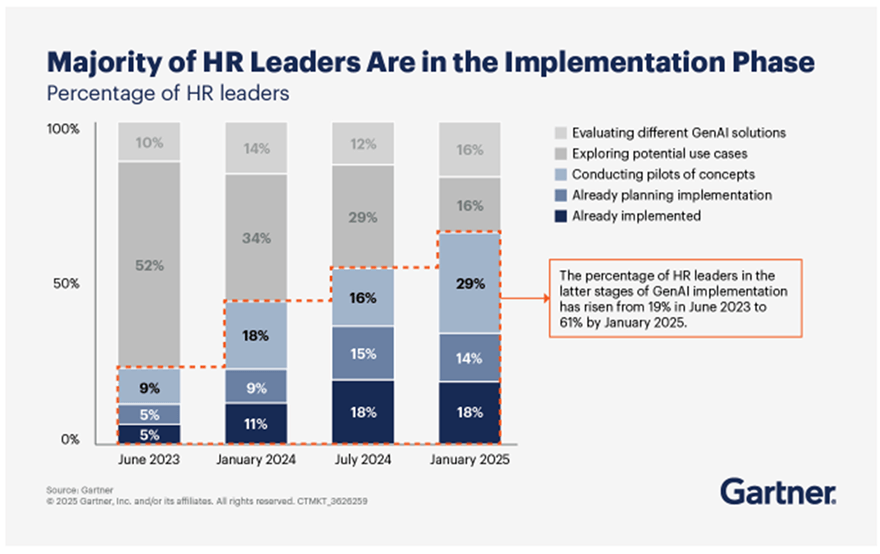
There remain significant opportunitiesto get ahead of the competition: only 18% of those surveyed by Gartner have actually implemented their Artificial intelligence in HR strategy. There is still plenty of early mover advantage to be gained with an AI integration into HR catch-up strategy. With 62% of CEOS surveyed by Gartner believing that “AI will define the next business era”, the AI in HR call to action is clear.
Data-driven decisions & efficiency gains
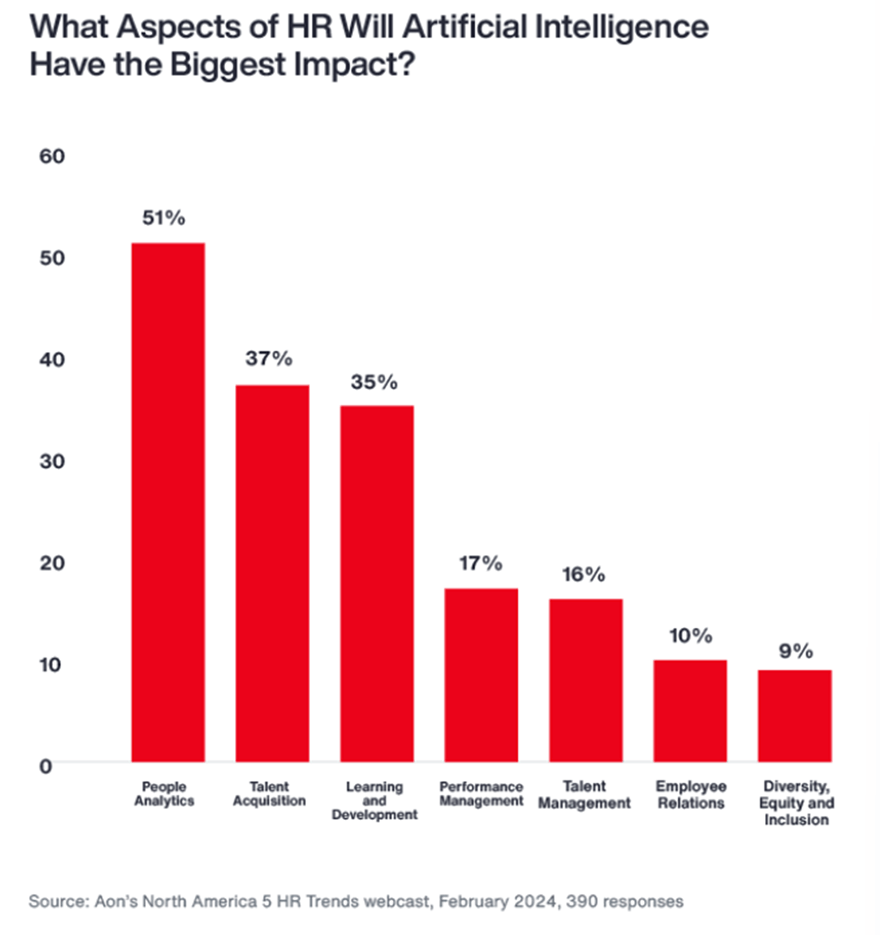
HR leaders are shifting from intuition-based methods to making decisions based on data, but progress has been slowed by the limited availability and high cost of effective tools. Emerging tools that use AI for HR analytics are the catalyst for change: research from AON shows that People Analyticsis the area of HR that will be most significantly impacted by AI.
Examples of AI Integration in HR processes
Recruitment & Talent Acquisition (AI screening, CV parsing and chatbots for candidates)
AI software can do much of the legwork in the hiring process; for example: it can CV parse, (read CVS), and auto enter them into HR systems, it can screen and shortlist CVs against job criteria. The vast majority of organisations use AI for this and many are now making use of an AI agent to scan social and personal websites to supplement CV information for screening purposes.
AI chatbots (used by about 40% of companies) can now have meaningful exchanges with job seekers, handling routine queries and rescheduling interviews. AI can even conduct interviews, (usually 1st round) and currently around 1 in 5 organisations are doing this.
Employee Onboarding (Personalised journeys, AI-powered training)
Though still in its infancy, we are seeing the emergence of AI-powered onboarding with around 30% of companies using AI for HR onboarding and new hire training. Using a combination of chat-bots and AI powered learning management systems new hires can be given tailored and highly personalised journeys into the organisation.
Performance Management (AI-driven feedback, predictive performance trends)
The traditional annual performance review is now widely seen as too slow and inflexible for today’s fast-moving workplaces. Organisations increasingly favour agile performance management cycles that happen quarterly, or even monthly. Modern AI tools make this possible by automating review scheduling, supporting smarter goal setting, delivering real-time feedback, assisting with performance scoring, and generating instant, data-rich reports that can predict future performance trends.
Employee Engagement & Retention (sentiment analysis, pulse surveys)
In today’s fast-changing world, employee mood and sentiment can shift quickly, and relying on a single annual satisfaction survey simply won’t cut it. HR leaders need real-time insight into how internal and external developments are affecting their people so they can make timely, targeted interventions to maintain engagement. One of the benefits of AI in HR is the arrival of AI-driven sentiment analysis. Modern AI-powered pulse survey apps can design questions and automatically collect employee feedback at scale and generate instant reports for managers. In effect, they give leaders a continuous “finger on the pulse” of workforce sentiment, enabling more responsive and informed decision-making.
Learning & Development
Language learning platforms like Duolingo show how far AI-powered learning has progressed, delivering effective language instruction through a mobile app without the need for a human teacher. These systems provide personalised, on-demand learning pathways that adapt dynamically to each learner’s strengths and weaknesses. Similar workplace AI learning technologies have arrived which support personalised career development by automatically identifying skill gaps, recommending tailored training, and guiding employees through customised learning journeys.
Absence & Workforce Planning (AI forecasting, scheduling optimisation)
AON has highlighted how Artificial Intelligence in HR is being used to actually forecast lost productivity as a result of illness and can actually go as far predicting future disability and early retirement due to health issues.
Benefits of Using AI in HR
Efficiency & time savings. Chatbots, and the various agents that automate routine tasks,(like interview shortlisting, meeting scheduling and CV sifting) save significant time and money.
Improve employee experience. Chatbots that handle HR queries instantly and AI-powered candidate relationship management tools can improve the responsiveness of HR, enhancing the candidate and employee experience
Better decision-making with analytics. Data is at the heart of enhanced modern-decision making in all areas of life and business, and AI in HR can quickly collect and process data around candidates and employees and produce actionable reports to enhance decision-making.
Reduced bias in hiring. When well-designed, AI can remove demographic details and standardise assessments and evaluations, reducing bias.
Challenges and Risks of AI in HR
Ethical concerns & bias in algorithms. This represents one of the key challenges of AI for HR adopters: if the data used to train AI is biased the AI will be too. A BBC-reported case at Amazon showed this: their experimental hiring app learned from male-dominated historical data and proved to be biased against women. AI software designers must take a careful approach to ensure that tools are trained without bias with diverse data sets.
Data privacy & security. Generative AI tools such as ChatGPT may use your inputted data internally to train AI models, but you can opt out of this here. Business products such as ChatGPT Business and ChatGPT Enterprise do not share the data internally and this is private. Businesses should make themselves aware of the privacy protocols of any AI tool they use.
Change management & adoption barriers: The process of integrating AI into HR involves automating and replacing repetitive tasks which can lead to significant changes to job descriptions and even redundancy, which can cause slow adoption and/or resistance to uptake.
The Future of AI in HR
AI + HR analytics & predictive tools
AI-powered HR analytics are evolving from basic reporting dashboards into intelligent systems that offer predictive analytics into workforce trends. Today, organisations use AI to forecast turnover risk, identify capability gaps, and spot patterns in data to improve employee performance. In time these tools may offer recommended actions, suggesting targeted interventions for at-risk teams, highlighting emerging skill shortages, or modelling the impact of organisational changes.
Generative AI for employee support.
The future of AI in HR promises big things in employee support. In years to come we will see generative AI specialist chatbots that can provide prompt-based support in the areas of financial well-being, emotional well-being, coaching and mentoring etc. We will also see the arrival of the HR AI agent that can work autonomously without the intervention of humans and perform isolated functions such as talent acquisition, flight risk identification etc.
AI shaping HR leadership decisions
AI is influencing strategic HR decisions by providing leaders with a deeper, real-time understanding of their workforce. Initially, this meant automated reporting and basic trend analysis. But as AI models become more advanced, they can generate large amounts of organisational data, from engagement surveys to productivity metrics and present this to HR leadership with clear, actionable recommendations. In time, AI may act as an intelligent advisor, like in Albania which has appointed the world’s first AI Minister.
FAQs
– AI hiring apps for CV screening and candidate shortlisting
– Chatbots that answer HR queries and support onboarding
– AI-driven learning platforms that identify gaps and personalise training
– Predictive analytics supporting datadriven decisions by HR leaders
– Automated scheduling for job interviews, work shifts, and performance reviews
Generative AI in the form of an onboarding chatbot can support onboarding by acting like the traditional buddy. It can provide on the spot answers to transactional queries about employment terms, procedures, policies etc.
AI can help reduce hiring bias, but only if it’s designed and monitored correctly. When built correctly, AI can for example, facilitate ‘blind hiring’ by removing the demographic details of job seekers. But if the training data is biased, the AI will be too. A BBC-reported case at Amazon showed this clearly: their experimental hiring tool learned from male-dominated historical data proved to be disadvantaging women.
Human centred AI in HR means AI that is designed to support HR professionals and not to simply automate away their work or replace them. Human centred AI interventions include generative AI like ChatGPT that enhances HR’s ability to work and extends their abilities. In short, human centred AI ensures that AI does the heavy lifting but the thought and final decisions remain with HR.
Small HR teams can adopt HR automation with AI responsibly by using an AI-usage policy. They can also use the UK government’s Artificial Intelligence AI PlayBook which gives guidance on the ethical use of AI in HR.
AI is currently performing two key roles in HR. The first is to deliver HR automation with AI by performing repetitive tasks. The second role of AI in HR is to provide HR professionals with enhanced capabilities via generative AI so they can complete advanced HR tasks like policy design and data analysis.
– Recruitment automation tools used to automatically sift CVs and shortlist candidates
– Scheduling assistants used to automatically schedule interviews, shifts and appraisal interviews
– Chatbots are being used to answer candidate and employee queries.
– Automation of mundane tasks like CV sifting and interview shortlisting, e-mail acknowledgements to job seekers and candidate rejections.
– AI chatbots can now engage with job applicants and handle queries about the job and company and can also answer onboarding questions for new hires and answer routine HR questions for employees like, “how many holidays do I have left?”
– AI assistants can help HR with automated scheduling of interviews, shifts and appraisals
This is just the tip of the iceberg,
AI is coming to help HR in the form of generative AI that can make HR leaders more efficient and effective in their responsibilities and give HR professionals new capabilities. However, AI also has a role to play in HR in replacing monotonous tasks, like CV sifting, and interview scheduling.
Companies are using AI at every stage of the HR process. This includes the automation of the search for, screening of and communication with candidates. Support chatbots are now taking on the role of 1st line support answering routine, transactional HR queries for candidates, new hires and employees. AI based learning apps are being used in onboarding and L&D to provide personalised Duolingo style learning pathways which diagnose gaps and deliver personalised learning journeys focused around career goals.
The primary challenges of AI integration into HR are related to change. AI can require the reengineering of HR processes which involves eliminating legacy ways of working and potentially entire roles. This can be met with resistance and a formal approach to change management may be needed.



