Emergency Evacuation Staff Tracking That Works
Emergency evacuation staff tracking gives site leaders a faster, evidence-based roll-call, clearer exceptions and safer decisions when every minute matters.
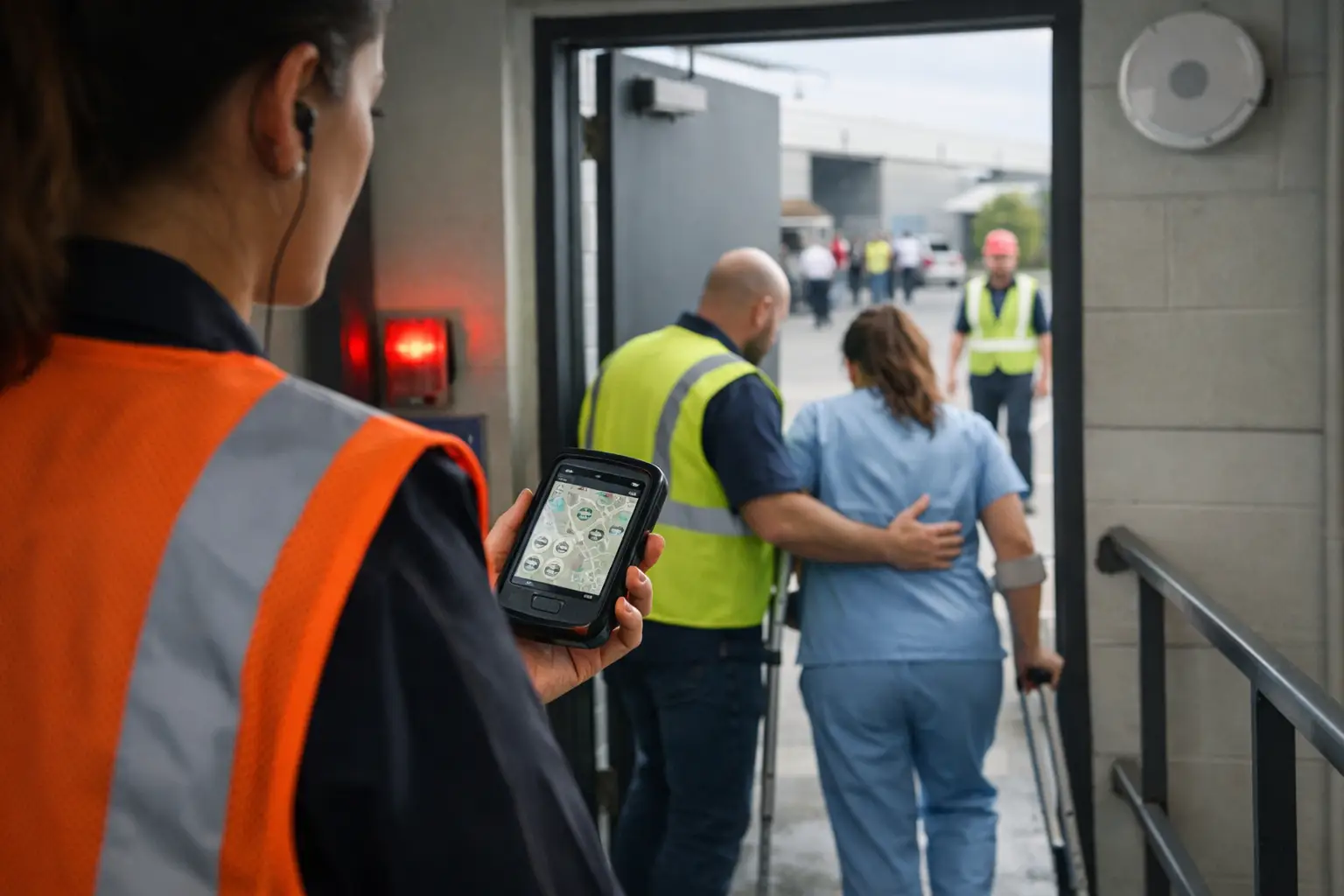
A fire alarm sounds during a shift change. Contractors are signing out, agency workers are covering breaks, and two team members are somewhere between the warehouse and the loading bays. Emergency evacuation staff tracking is the difference between a roll-call based on assumptions and one based on a current, defensible picture of who may still need help.
For organisations with deskless, mobile or multi-site teams, the problem is rarely a lack of evacuation procedure. It is that the records used to support it are incomplete, delayed or disconnected from where people actually are. A paper signing-in book may be at reception. A time and attendance clock may confirm that someone started work, but not that they left. A supervisor may know their own team, but not visitors, contractors or colleagues working in another area.
A reliable approach joins physical-world evidence with a clear emergency workflow. It helps responsible people identify who is on site, account for people at an assembly point and focus attention on exceptions rather than reading names from an outdated list.
What is emergency evacuation staff tracking?
Emergency evacuation staff tracking is the process of establishing who is present at a site when an emergency occurs, then recording whether each person has reached safety or requires further action. It supports evacuation roll-calls, incident response and post-event records.
It should not be confused with general employee monitoring. Its purpose is specific: to provide site teams with timely, proportionate information during a safety-critical event. The strongest systems draw on verified attendance and location signals rather than relying only on manually maintained lists.
In practical terms, the system needs to answer three questions quickly:
- Who was expected to be on this site or in this zone when the alarm occurred?
- Who has been confirmed safe at the assembly point?
- Who remains unaccounted for, and what is the last reliable information available to support a response?
The quality of the answer depends on the quality of the underlying data. If clock-ins can be missed, shared or corrected days later, the roll-call begins with uncertainty. If presence is verified through hardware-backed events, the starting point is stronger.
Why conventional roll-calls fail under pressure
Manual roll-calls can work well for a small, stable office. They become harder to manage in a hospital, retail estate, factory, logistics operation or facilities contract where shifts overlap and people move between work areas.
The first weakness is the source list. A printed register may have been produced before late arrivals, early leavers and contractors were added. A manager may have a team rota but no visibility of cleaners, drivers, visitors or maintenance engineers. Even a digital HR record typically shows employment status, not confirmed current presence.
The second weakness is reconciliation. At an assembly point, a marshal needs to record people as they arrive, identify absent names and avoid counting someone twice. This takes time when people have moved between muster points, forgotten to clock out or joined a different team for the shift.
Finally, a manual process creates a poor audit trail. After an incident, organisations may need to establish what happened, which checks were completed and when an escalation was made. Reconstructing this from paper sheets, radio calls and memory is slow and can leave important gaps.
Build the roll-call on verified presence
Effective evacuation management begins before an alarm. It starts with a dependable record of attendance that reflects the physical workplace.
Badges, clocks, gateways, tags, sensors and wearables can each provide relevant signals, depending on the environment. A clock or badge event can verify entry. Indoor and outdoor location intelligence can add context about the relevant site or operational area. A visitor process can capture non-employees who need to be included in the same emergency view.
No single technology is right for every estate. A reception-based office may need straightforward badge or clock events. A large manufacturing plant may need a combination of entry control, zone-aware signals and designated muster points. A mobile facilities workforce may need to distinguish between people at a customer site, in transit and off duty.
The operational requirement is not to collect every possible signal. It is to establish a reliable, understandable presence state: on site, accounted for, unaccounted for or not expected to be there. That state should be visible to the people responsible for the response without forcing them to search across HR, rota, visitor and timekeeping systems.
A practical evacuation workflow
When an alarm is raised, the system should create an incident view from the most recent verified presence data. The roll-call should then be actively updated at the assembly point, rather than treated as a static export.
A marshal can confirm people safe through a controlled process, while the incident lead sees the exceptions. If an individual remains unaccounted for, the response team has an evidence-based starting point, such as their assigned work area or last confirmed presence event. This is useful information, but it is not a substitute for emergency services procedures or a reason to delay escalation.
Once the event is closed, the system should retain a clear record of the initial list, confirmations, outstanding exceptions, timestamps and actions taken. That supports internal review, safety management and improvements to future drills.
The data model matters as much as the screen
Many evacuation tools look convincing in a demonstration because they display a list of names. The more useful question is how that list was created and maintained.
A workforce platform connected only to a rota may know who was scheduled. A platform connected only to a clocking system may know who recorded a shift start. A location-aware workforce system can combine these facts with hardware-generated evidence of attendance and movement, giving operations teams a better basis for action.
This is where frontline intelligence becomes operationally valuable. The same presence data can support verified timesheets, payroll checks, lone-worker workflows, task validation and site visibility. It reduces the need for separate datasets that disagree with one another when time matters most.
Sense Workplace, for example, connects workforce software with proprietary workplace hardware and location intelligence. Its Presence platform is designed to connect indoor and outdoor location to attendance and timesheets, creating a practical foundation for emergency roll-calls alongside day-to-day workforce operations.
The benefit is not simply another safety dashboard. It is a connected operating layer in which people, places, events and workflows are linked by evidence from the physical workplace.
Privacy, proportionality and workforce trust
Location-aware evacuation capability must be designed carefully. UK organisations should be clear about why data is collected, what data is necessary, who can access it, how long it is retained and how workers can raise questions. The Information Commissioner’s Office provides guidance on data protection accountability and monitoring at work, while employers also need to consider their own policies, risk assessments and workforce consultation arrangements.
The appropriate design depends on the risk and setting. A high-risk industrial site may justify more frequent location evidence than a small, low-risk workplace. A system that keeps detailed movement data indefinitely may be disproportionate if its only purpose is attendance. Good governance sets boundaries around use, not just technical permissions.
Transparency also improves operational adoption. Staff are more likely to engage with badges, clocks or wearables when the organisation explains the practical outcomes: accurate pay, faster resolution of disputed hours, safer lone-working processes and clearer evacuation accountability. The message should be about verified work and safety, not surveillance for its own sake.
How to assess an evacuation tracking solution
Buyers should test an evacuation solution against real operating conditions, not an idealised office scenario. Ask how it handles agency staff, visitors, contractors, split shifts, temporary muster points, poor connectivity and people moving between sites.
Consider whether the system can distinguish scheduled presence from verified presence. Check how quickly a current roll-call can be produced, how confirmations are recorded and what information is available for unaccounted people. Establish whether the system can work alongside existing HR, payroll, access control and operational tools through integrations or an open API, rather than requiring a full technology replacement.
It is equally important to define accountability. Technology can provide the list and workflow, but managers, marshals and incident leads still need clear responsibilities, training and regular drills. The Health and Safety Executive expects employers to plan for emergencies and put suitable procedures in place. A digital roll-call strengthens that plan when it reflects the reality of the site.
FAQ
Is emergency evacuation staff tracking the same as access control?
No. Access control records who passed through a controlled entry point. Emergency evacuation staff tracking uses attendance, visitor and, where appropriate, location evidence to establish current presence and manage the roll-call during an incident. Access events can be a valuable input, but they are not always the complete picture.
Can evacuation tracking include contractors and visitors?
It should. Contractors, agency workers and visitors can be at greater risk of being missed because they may not appear on an employee rota. A workable process needs a clear way to register them and include them in the emergency presence list.
Does location data replace a physical roll-call?
No. Location data can identify likely presence and support response decisions, but the evacuation process still needs a positive confirmation that a person has reached safety. The value is speed, clarity and stronger exception management.
What should be tested during an evacuation drill?
Test the accuracy of the initial presence list, the time required to confirm people at muster points, treatment of visitors and contractors, escalation of unaccounted people, communications between marshals and the incident lead, and the quality of the event record afterwards.
The aim is simple: when people leave a building, managers should not be left guessing who was inside. Build the evidence before the alarm, make the response clear when it happens, and use every drill to remove the uncertainty that slows a safe decision.



