Real-Time Employee Location Tracking at Work
Real-time employee location tracking gives frontline teams verified attendance, safer lone working and faster, evidence-led decisions across every site.
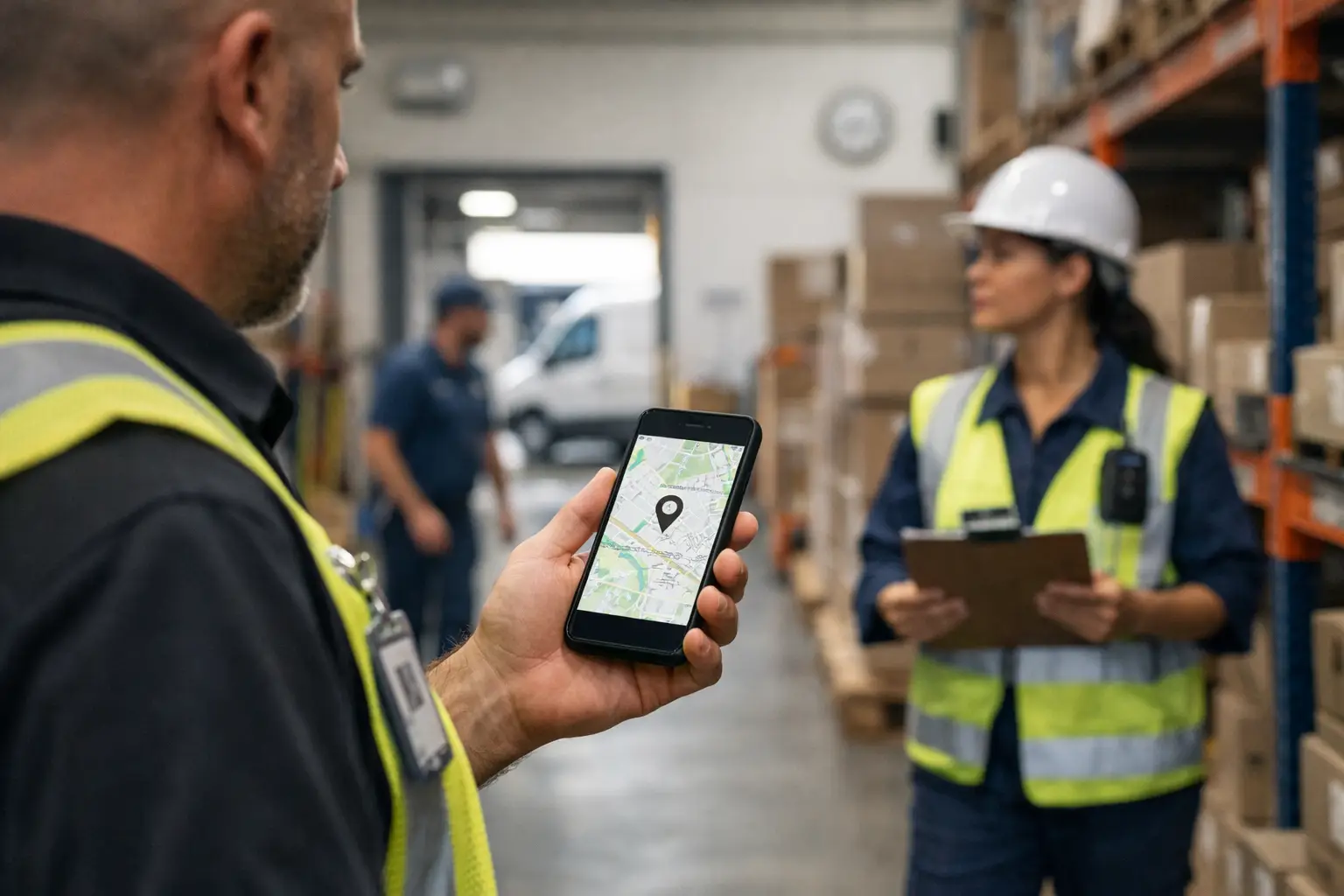
A disputed shift is rarely just a payroll problem. It can mean a manager has no proof of when a contractor arrived, a lone worker cannot be located after a missed check-in, or an evacuation lead cannot confirm who remains on site. Real-time employee location tracking addresses these gaps by connecting workforce records to evidence from the physical workplace.
For organisations with mobile, shift-based or multi-site teams, that evidence needs to be useful at the moment a decision is required. Knowing that someone was scheduled to work is not the same as knowing they arrived at the right location, completed a location-specific task or safely left a restricted area. The distinction matters to operations, payroll, health and safety, and service delivery.
What real-time employee location tracking means
Real-time employee location tracking is the use of authorised location signals to show where a worker is, or was, within an operational context. Depending on the work environment, this may mean confirming presence at a site, identifying a worker’s position outdoors, or establishing a more precise indoor location.
It is not one technology. Outdoor location can draw on GPS-enabled devices, while indoor environments often require hardware designed for the site, such as badges, clocks, gateways, tags, sensors or wearables. GPS can be useful across large external areas, but its performance indoors may be limited by buildings and local conditions. A warehouse, hospital, production floor and city-centre retail estate therefore need different location designs.
The operational value comes from joining location data with other events. A location signal on its own says little. Connected to a shift, a clock-in, a task, an incident alert or a site zone, it can provide a clearer record of what happened and what action is needed next.
Why location intelligence belongs in workforce operations
Traditional HR and time-and-attendance systems hold essential information: employee records, rotas, leave, pay data and contractual rules. But they do not necessarily know whether a person was physically present at the location connected to an event. That leaves supervisors reconciling paper records, phone calls, spreadsheets and disputed timesheets after the fact.
Location-aware workforce operations can reduce that uncertainty. An employee badge or clock can contribute evidence of attendance. A gateway or sensor can establish that a worker entered a defined area. A wearable can support an agreed safety workflow. The system can then connect those verified events to time records, task validation, payroll checks or emergency processes.
This is not about watching people for its own sake. It is about giving managers proportionate evidence for specific operational purposes: accurate pay, site safety, attendance verification, workflow control and faster incident response. The right level of detail depends on the role and risk. A mobile facilities engineer may need outdoor site confirmation, while a worker in a high-risk manufacturing area may need a defined-zone safety process.
Verified attendance and payroll control
Clocking in is more credible when it is tied to a physical workplace event rather than a self-reported time alone. This can help payroll and operations teams investigate exceptions before payroll is processed, rather than correcting them after a payslip has been issued.
It does not remove the need for judgement. A late arrival may be legitimate; a missed clock event may reflect a hardware fault or an operational emergency. The benefit is that managers can review a clearer evidence trail, apply agreed rules consistently and focus on exceptions rather than checking every shift manually.
For sectors using agency labour, dispersed contractors or frequent shift changes, that control can also support more constructive conversations. Instead of debating recollection, the manager and worker can review the relevant attendance and location events.
Safer lone and mobile working
A lone-worker policy is only as useful as the response it enables. If an employee does not check in, raises an alert or suffers a safety event, the person coordinating the response needs reliable context: who the worker is, their last known operational location and whether they are due to be at a particular site or zone.
Location intelligence can support this process when it is designed alongside clear escalation procedures, training and responsible people. Technology cannot replace competent risk assessment or emergency planning. It can, however, make it easier to identify who may need assistance and reduce the time spent trying to establish basic facts.
Faster emergency roll-calls
During an evacuation, a rota is not an accurate roll-call. It may include people who never arrived, omit visitors or contractors, and fail to show who has already left. A presence record linked to site entry, attendance and designated zones can give incident leaders a stronger starting point.
That still requires a practical evacuation process. People may move rapidly, devices may be unavailable, and a live system should support rather than replace trained fire marshals and local procedures. But a current, evidence-backed view of who is expected to be on site can improve decision-making when time is limited.
How a practical tracking system is built
The strongest approach begins with the decision the organisation needs to make, not with a map. Ask whether the priority is proving attendance, protecting lone workers, supporting an emergency roll-call, validating tasks or coordinating people and assets across a site. That answer determines the suitable hardware, location method, data retention and workflow.
A well-designed deployment usually combines four elements:
- A defined operational event, such as arrival, departure, entry to a controlled zone, task completion or safety alert.
- Appropriate physical-world hardware, including clocks, badges, gateways, tags, sensors or wearables where required.
- Workforce rules that explain how events affect attendance, approvals, notifications and payroll checks.
- Clear ownership for exceptions, privacy queries, device management and incident response.
The hardware matters because it provides a bridge between digital records and physical reality. A mobile app may be suitable in some roles, but it can depend on battery levels, connectivity and individual device use. Dedicated workplace hardware can provide a more consistent method for defined sites and operational workflows.
Sense Workplace applies this model through its Presence platform, connecting indoor and outdoor location intelligence with attendance and timesheets. Its own hardware family is built to capture workplace events through badges, clocks, gateways, tags, sensors and wearables, then make that evidence available to workforce workflows and connected systems.
Privacy, fairness and UK compliance considerations
Employee location data is personal data. Organisations must treat it accordingly. The ICO’s guidance on employment practices makes clear that monitoring should be lawful, fair, transparent and proportionate. Workers should understand what is being collected, why it is needed, when it applies, who can access it and how long it will be kept.
The practical test is necessity. Continuous location tracking outside working time, or collecting more precision than the stated purpose requires, is difficult to justify. A system designed to verify arrival at an assigned site should not quietly become a tool for unrestricted monitoring.
Before deployment, organisations should document the purpose, assess privacy risks, consult relevant stakeholders and set clear policies. A data protection impact assessment may be appropriate where monitoring is likely to create a high risk to workers’ rights and freedoms. Access controls, retention schedules, audit logs and a process for challenging inaccurate records are equally important.
Engagement matters commercially as well as legally. Explain the problem being solved in operational terms. If employees see that a system helps resolve incorrect hours, supports safer lone working and removes unnecessary admin, adoption is more likely to be constructive. If it appears punitive or opaque, data quality and trust will suffer.
Where real-time location data produces the clearest value
The use case should reflect the environment. In facilities management, a team may need evidence that a service visit occurred at the correct site and time. In logistics, supervisors may need a live understanding of who is working in a yard, warehouse or distribution area. In healthcare, the emphasis may be on staff safety and controlled access. In hospitality and retail, site presence can support shift coverage and faster response to operational issues.
Manufacturing illustrates the need for balance. Location-aware data may help confirm attendance, support restricted-zone controls or assist emergency roll-calls. Yet the design must avoid collecting data that has no connection to safety, productivity or a defined workflow. More data is not automatically better data.
For organisations with established HR, payroll or operational systems, location intelligence does not require a wholesale replacement strategy. An integration layer and open API can allow verified events to supplement existing records, while teams retain the systems already used for payroll processing, HR administration or enterprise reporting.
Choosing a system: questions that prevent expensive gaps
A credible evaluation should move beyond a map demonstration. Buyers should ask what the system can verify, how it verifies it, and what happens when a signal is missing or disputed. They should also test the physical environment: dense indoor spaces, external yards, poor connectivity, shared devices and high-turnover workforces all affect design.
Ask whether the platform can connect location to attendance, safety events, tasks and payroll checks without creating manual reconciliation work. Confirm whether its hardware is suited to the work, how devices are administered, and whether data can flow into existing systems. Finally, test governance: permissions, retention, employee communications, auditability and exception handling should be designed before the first device is issued.
Frequently asked questions
Is real-time employee location tracking legal in the UK?
It can be, provided it is used lawfully and fairly under data protection law. The organisation needs a clear purpose, a proportionate design, transparent communication and appropriate safeguards. Legal and data protection advisers should assess the organisation’s specific circumstances, especially where monitoring is extensive or sensitive.
Can location tracking be used for payroll?
Location data can support payroll checks by providing evidence linked to attendance events, such as arrival at an assigned site or clocking activity. It should support a defined approval process rather than automatically treating every data point as final proof of worked time.
Does employee location tracking work indoors?
It can, but the method matters. GPS alone is often unsuitable for detailed indoor use. Site-designed infrastructure such as badges, gateways, clocks, sensors and tags can provide location or presence evidence appropriate to the operational requirement.
Will it replace managers or safety procedures?
No. It gives managers and safety teams better evidence and faster visibility, but it does not replace supervision, risk assessments, worker training or emergency procedures. The most useful systems make those human decisions better informed.
The right outcome is not a fuller map of every employee. It is a more reliable operating picture: the right person, at the right place, connected to the right action when the business needs certainty.



