AI Agents Versus HR Automation: What Changes?
AI agents versus HR automation: see how frontline teams can combine specialist decisions with verified attendance, safety and payroll workflows every day.
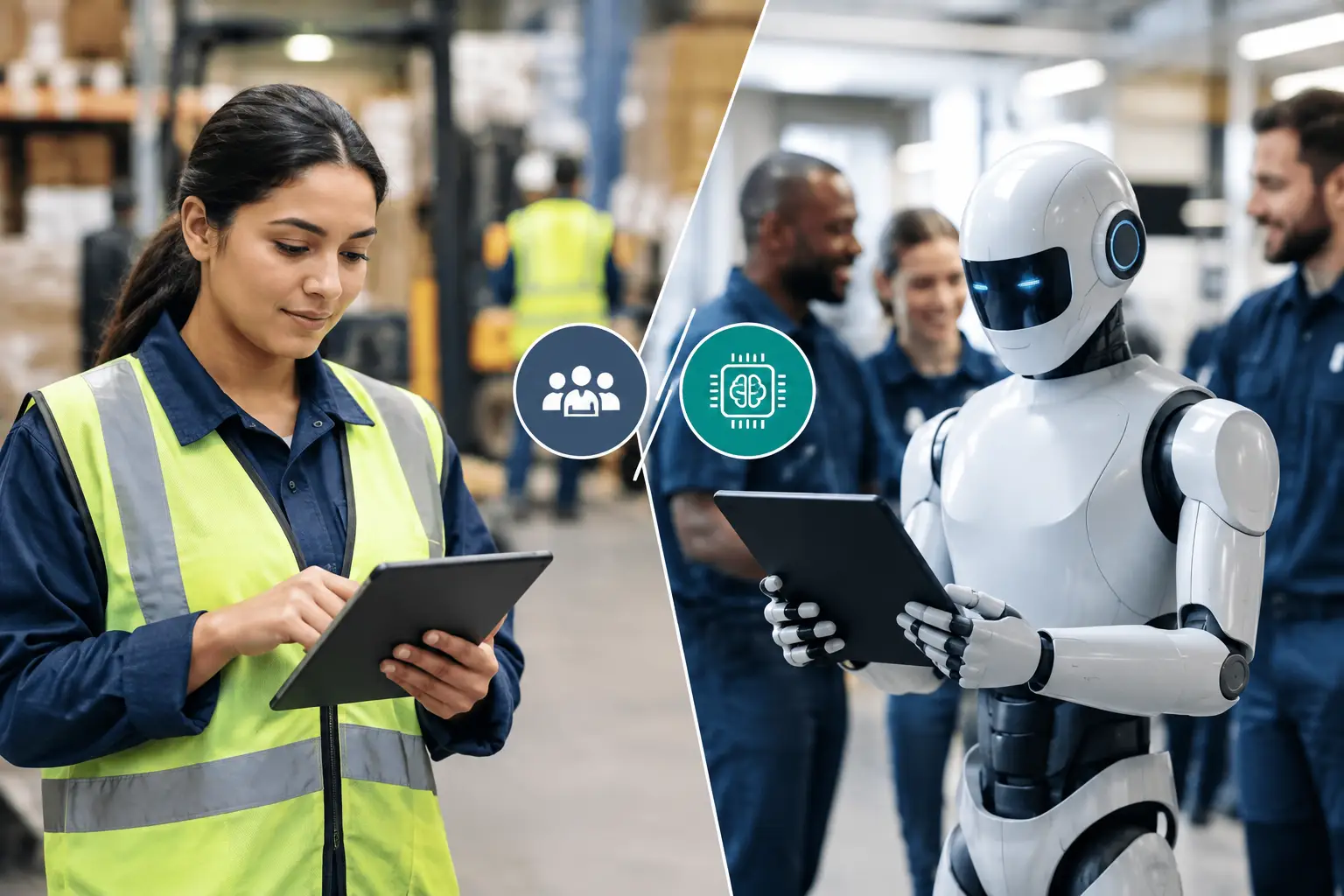
A disputed timesheet at the end of a shift is rarely just an HR issue. It can delay payroll, create friction with employees, leave a client service claim unresolved and force managers to reconstruct events from messages, paper records and memory. AI agents versus HR automation matters because each solves a different part of that operational problem – and neither can establish physical-world facts without reliable evidence.
For organisations running mobile, shift-based or multi-site teams, the practical question is not which technology sounds more advanced. It is which system can confirm who was present, where work was carried out, whether a required workflow happened and what action should follow.
AI agents versus HR automation: the direct answer
HR automation follows predefined rules. It moves information, triggers notifications and completes repeatable administrative steps once a condition is met. An AI agent is designed to perform a defined workforce task using context, instructions and available data. It can assess information, identify exceptions, request missing detail and prepare a recommended or completed next action within agreed boundaries.
For example, HR automation can send a new starter a right-to-work reminder seven days before their start date. A recruitment AI agent may review an application against role criteria, identify missing information and progress suitable candidates through a defined screening workflow. The distinction is judgement within a task, not simply conversation.
Neither should be treated as a substitute for accountable management, HR oversight or proper employment processes. The value comes from assigning each technology the work it is suited to, with clear controls over what it can access, decide and escalate.
What conventional HR automation does well
Most HR automation is event-driven. A form is submitted, a date arrives, a manager approves a request or a timesheet reaches a cut-off. The system then performs the next prescribed step. This is highly useful for consistent, high-volume administration.
In a frontline environment, automation can issue onboarding tasks, chase expiring documents, route holiday requests, update employee records, send absence notifications and export approved hours to payroll. It reduces handoffs and makes standard processes less dependent on individual managers remembering what comes next.
Its limitation is that it only knows what it has been given. If a worker clocks in remotely, an ordinary workflow can record that clock-in. It cannot, by itself, establish whether the person was at the assigned site, whether a shift was completed, whether a lone worker has checked in after a risk event or whether a service task has been performed.
That gap becomes expensive when hours are disputed, sites are dispersed or operational evidence is fragmented. Automation moves data efficiently. It does not create trustworthy physical-world data.
What specialist AI agents add
A specialist AI agent is not a generic chatbot placed over an HR database. It is configured around a specific workforce job, such as reviewing timesheet exceptions, screening recruitment information, preparing payroll queries or processing routine HR requests.
Consider a payroll team dealing with late amendments every pay period. An agent could gather the relevant records, compare a submitted amendment with the worker’s scheduled shift and attendance evidence, identify where a manager approval is needed and prepare the case for review. The agent is handling the investigation workflow; a defined approval process still governs the outcome.
This is particularly useful where work generates many small exceptions rather than one straightforward transaction. A missed clocking, a changed location, an early departure or a duplicate entry may require different evidence and different escalation routes. Rules alone can become difficult to maintain when every exception needs interpretation.
However, AI agents are only as dependable as their task design and the information available to them. If attendance data is incomplete, schedules are inaccurate or site records sit in disconnected systems, an agent may speed up an unreliable process. Businesses should start with narrow, measurable use cases and test how decisions are reviewed before extending an agent’s remit.
The missing layer: verified frontline intelligence
For deskless workforces, the strongest automation and AI workflows begin with better source data. A payroll process may know that eight hours were submitted. Frontline intelligence can add evidence of attendance and, where appropriate, the worker’s presence at an assigned place during the relevant period.
This is where purpose-built workplace hardware has a distinct role. Badges, clocks, gateways, tags, sensors and wearables can capture events in the places where work occurs. Connected with workforce software, those signals can support attendance records, time calculations, task validation, safety workflows, emergency roll-calls and operational visibility.
The important point is not to collect location data for its own sake. It is to answer an operational question with proportionate evidence. Was the engineer at the customer site for the booked appointment? Has the night-shift employee checked in? Who may be in a defined area during an evacuation? Has a required task been completed at the location where it was due?
Sense Workplace positions this as an operating layer for frontline work: connecting people, places, events and workflows while complementing existing HR, payroll and operational systems. Its Presence platform connects indoor and outdoor location with attendance and timesheets, supported by hardware built by Sense engineers. That creates a stronger factual basis for the HR automation and specialist AI agents that act on workforce events.
A practical comparison for operations leaders
The difference becomes clearer when viewed through common frontline scenarios.
Verified attendance and payroll
HR automation can collect submitted hours, apply approval rules and send approved data to payroll. An AI agent can investigate irregular entries or organise supporting information for a payroll query. Hardware-backed attendance and location intelligence can provide the evidence that helps establish whether recorded hours align with attendance at the relevant workplace.
This does not mean every difference is misconduct. Shift changes, authorised overtime, technical failures and legitimate travel all occur. The benefit is faster, evidence-led resolution rather than blanket assumptions or manual detective work.
Lone-worker safety and incidents
Automation can schedule check-ins and escalate missed responses. An AI agent can assemble incident details, identify incomplete reports and route follow-up actions. Wearables, badges and location-aware infrastructure can add a time-stamped safety event or location context, subject to the organisation’s configuration and policies.
For a facilities, logistics or healthcare operation, that distinction matters. A missed check-in is an administrative event until it is connected to the information needed for a proportionate response. Safety leaders need visibility that supports action, not another dashboard to review after the fact.
Recruitment and onboarding
Automation is effective for issuing forms, reminders and training tasks. Specialist recruitment agents can support defined work such as candidate screening, information capture and progression through agreed stages. Yet recruitment automation should retain clear human accountability, particularly where decisions may materially affect candidates.
The operational objective is speed with consistency. A new starter should reach their first shift with the right records, access and instructions in place, without HR teams manually chasing every step.
Design the operating model before choosing the tool
The best approach is usually not an either-or decision. Use workflow automation for stable, repeatable actions. Use AI agents where a defined process needs contextual analysis, exception handling or information gathering. Use frontline intelligence where the business needs evidence from the physical workplace.
Start by mapping the failure point. If payroll staff spend hours rekeying approved timesheets, automation may be enough. If they spend hours investigating why records conflict, an AI agent may help. If the underlying issue is that nobody can verify attendance at a site, the priority is stronger source data through the appropriate clocking, badge or location approach.
Then define the controls. Establish which data sources an agent can use, which actions it can take automatically, what requires human approval and how exceptions are logged. For UK organisations, workforce data design should also be assessed against data protection obligations. ICO guidance is relevant where personal data, including location information, is processed. The lawful purpose, transparency, retention and access controls should be designed into the workflow rather than added later.
Finally, measure the operational result. Useful measures include disputed-hours resolution time, payroll amendments, missing compliance records, overdue safety follow-ups, manager administration and the percentage of shifts supported by verified attendance evidence. These measures reveal whether technology has removed work or simply relocated it.
Where AI agents can go wrong
An agent should not be given broad authority simply because it can generate fluent text. Frontline work is full of exceptions: a worker may be moved between sites, a clock may be unavailable, a manager may approve an emergency extension or a location signal may need interpretation alongside the shift plan.
Poorly designed agents can also obscure accountability. If a system recommends a payroll amendment, HR and payroll teams must still be able to see the evidence, the rule or instruction applied and the person responsible for approving the result. Explainability is a working requirement, not a technical luxury.
The same principle applies to worker trust. Explain what data is collected, the operational reason for collecting it and who can access it. Evidence-led workforce management should reduce avoidable disputes, not create a culture of unexplained monitoring.
Frequently asked questions
Are AI agents better than HR automation?
Not automatically. HR automation is usually better for predictable, rules-based tasks. AI agents are more suitable for defined tasks involving exceptions, contextual review or information gathering. Most workforce operations need both.
Can AI agents approve payroll changes?
They can support the review and preparation of payroll changes if configured to do so, but organisations should set approval limits based on risk, policy and payroll controls. High-impact or unusual changes commonly warrant human review.
Does HR automation verify that someone worked their shift?
Not on its own. It can record submitted or clocked hours, but verification depends on the quality of the underlying attendance evidence. Hardware-backed clocks, badges and location intelligence can add relevant evidence where appropriate.
Is employee location data lawful in the UK?
There is no single answer for every use case. Organisations processing personal data need an appropriate legal basis, clear information for workers, proportionate collection and suitable safeguards. The ICO’s guidance should inform the design, alongside employment and workplace policies.
Do we need to replace our HR or payroll system?
Not necessarily. A frontline workforce layer can complement existing HR, payroll and operational platforms by connecting attendance, location, safety and workflow evidence to the systems already in use.
The useful question is not whether AI can automate HR. It is whether your workforce processes can turn verified events from the field into timely, accountable action.



